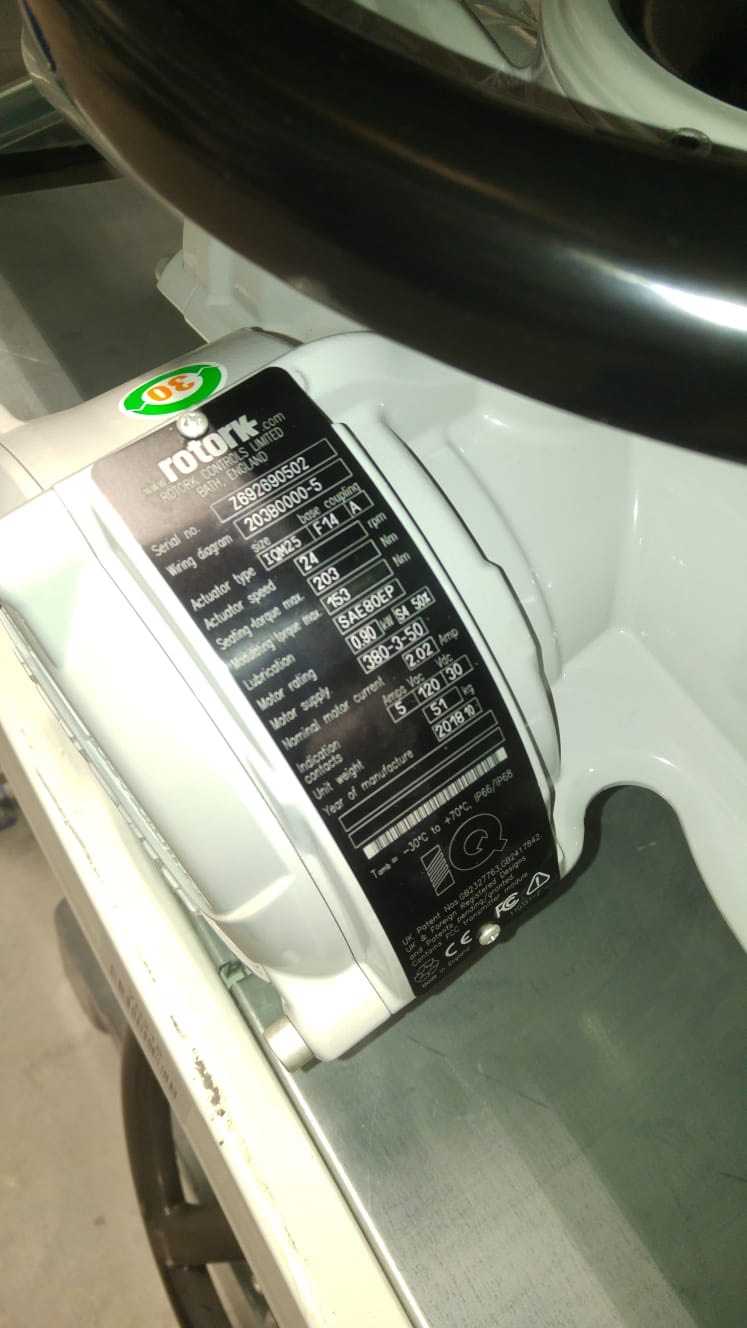

Z692690502 Rotork United Kingdom Sales
If you are looking for a reliable supplier where you can purchase the Z692690502 spare Actuator, you are in the right place. RADWARD sells all product groups belonging to the Rotork brand in the United Kingdom market, with fast delivery times and competitive prices.
Request a price
Delivery time:
Determined at the time of quotation
VISA
Mastercard
Bank Transfer
Technical Specification
IQM25 F14 A [IP68] 24RPM 380/3/50
Wiring diagram 203B0000
Wiring diagram 203B0000 is described in IQ/IQT Control and Monitoring publication (PUB002-041) and includes:
• CONTROL SUPPLY: 20 – 60VDC/40 – 120VAC or actuator derived 24VDC
• CONTROL INPUTS: 6 inputs for open, close, stop/maintain, ESD and interlock signals, 20 – 60VDC/40 – 120VAC
• INDICATION CONTACTS: 4 volt-free (SPST) latching contacts (S1-S4), rated at 120VAC/30VDC, 5mA to 5A, each configurable NO
or NC to signal one of the following; open/closed or intermediate positions, moving (continuous or pulsing), Handwheel
operation, local selected, remote selected, open/close interlock active, ESD active, motor tripped on torque in mid travel/going
open/going closed, valve jammed, loss of power/phase or control supply, battery low, internal failure detected, thermostat
tripped, programmable service alarms.
• MONITOR AND AVAILABILITY RELAY: Independent relay with volt-free changeover contact, rated at 120VAC/30VDC, 5mA to 5A.
De-energises in case of; loss of power/phase or control supply, local control or local stop selected (can be excluded), motor
thermostat tripped or detected internal failure
• ANALOGUE CONTROL/FEEDBACK: Proportional control over whole or part of valve stroke 0 to 5/10/20/mA or volt ranges,
internally powered 4-20mA output proportional to position (Folomatic/CPT). Configurable for open, close or stay-put on loss of
signal. Incorporates user adjustable deadband (percentage of signal) and motion inhibit time (seconds) for restricting hunting or
over modulation caused by a fluctuating control signal.